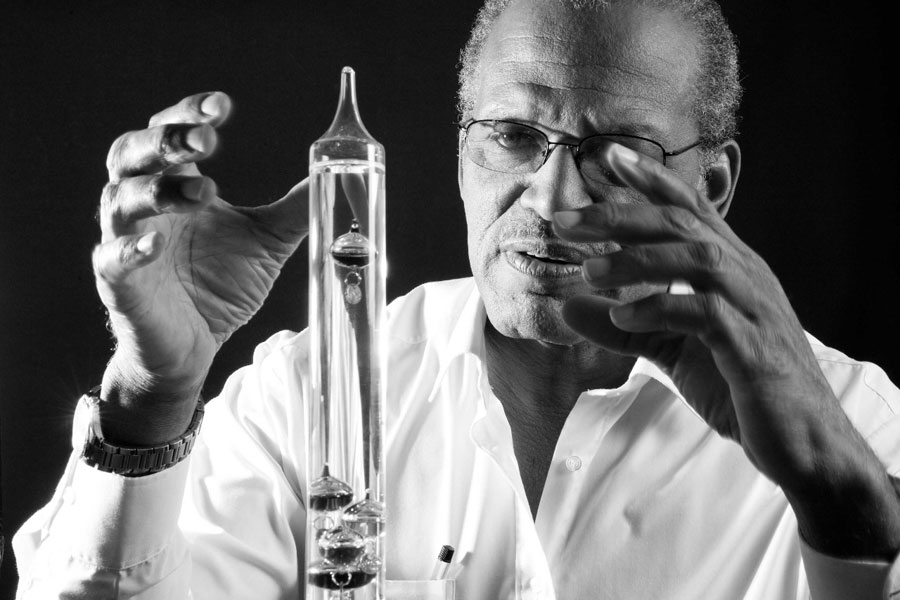
Professor Gift’s research interests include the design of electronic systems such as active filters, instrumentation amplifiers, current and voltage amplifiers and precision rectifiers. In the last five years he has had over 20 international refereed journal papers published. He also conducts research on the science of engineering and the nature of space, time and the fundamental forces. This work has yielded a new model of the electron that explains why electrons and protons have the same charge magnitude, as well as a new theory of magnetism that for the first time accounts for chemical reactivity, covalent bonds and the solidity of matter.
Biography
In 1973, Professor Stephan Gift was the winner of an AMOCO scholarship to study Electrical Engineering at UWI. He graduated with First-Class Honours, and placed second in his class, overall. He was awarded a UWI postgraduate scholarship and completed his doctoral degree in Electrical Engineering at age 24, the youngest PhD graduate in the Faculty’s history. Professor Gift later became Head of Research and Development at TSTT where he directed the development of advanced electronic systems and holds one international patent. He currently conducts research in science and engineering in the Department of Electrical & Computer Engineering and has published over 50 papers in international peer-reviewed journals. He has developed several new electronic systems and in a series of papers has challenged Einstein’s theory of relativity. He is also the first person in his department to be promoted to the rank of Professor. Professor Gift has received many awards including the Young Innovator’s Award in 1986, the UWI Guild of Graduates Pelican Award for Excellence in Science and Technology in 1993, the Prime Minister’s Special Award of Merit for Innovation in the Field of Electronics in 2002 and Friends of the Tobago Library Committee Individual of the Year Award for 2006 in recognition of outstanding contribution in Science.
A Dissertation in Microelectronics
In this paper, a new Quantum Theory of Magnetic Interaction is proposed. This is done under a relaxation of the requirement of covariance for Lorentz Boost Transformations. A modified form of local gauge invariance in which fermion field phase is allowed to vary with each space point but not each time point, leads to the introduction of a new compensatory field different from the electromagnetic field associated with the photon. This new field is coupled to the magnetic flux of the fermions and has quanta called magnatons, which are massless spin 1 particles. The associated equation of motion yields the Poisson equation for magnetostatic potentials. The magnatons mediate the magnetic interaction between magnetic dipoles including magnets and provide plausible explanations for the Pauli exclusion principle, Chemical Reactivity and Chemical Bonds. This new interaction has been confirmed by numerical experiments. It establishes magnetism as a force entirely separate from the electromagnetic interaction and converts all of classical magnetism into a quantum theory.
Linear Integrated Circuits
This paper presents a simple near constant bandwidth amplifier constructed from two operational amplifiers. The near constant bandwidth is obtained by reducing the normally high input impedance of the opamp via local and overall feedback. Experimental results obtained using identical opamps and different opamps verify the expected theoretical results. Copyright © 2009 John Wiley & Sons, Ltd.
Optimal Control Theory
A new necessary condition for singular optimal control problems is presented in this paper. The condition is simpler to apply than existing conditions and is easily derived from a Taylor series expansion of the performance index.
Invalidation of Einstein’s Theory of Relativity
The principle underpinning modern physics, which states that the speed of light is constant and independent of the motion of the source and the observer, is shown to be invalid.
Get new content delivered directly to your inbox.
 CariSTEM - Caribbean Science Technology Engineering Maths